Table of Contents
ToggleArizona’s tiny house market is booming, and for good reason. Between affordable land, year-round sunshine, and an increasing number of tiny-friendly communities, the state offers one of the most practical environments for downsizing without sacrificing quality of life. Whether someone’s looking for a minimalist retreat in the desert or a compact full-time residence near Tucson or Phoenix, the options have never been more diverse. This guide walks prospective buyers through where to find tiny houses for sale, what they’ll cost, how local zoning works, and what to watch for when making a purchase decision.
Key Takeaways
- Arizona’s 300+ days of sunshine and low land costs make it one of the most practical locations for tiny houses for sale, with rural lots under an acre often available for under $20,000.
- Turnkey tiny houses in Arizona typically range from $40,000–$75,000, while custom builds with solar and advanced systems can reach $80,000–$120,000+, with pricing heavily influenced by finishes and off-grid capabilities.
- Zoning regulations vary significantly by Arizona county and municipality—tiny houses on wheels are often classified as RVs, while permanent foundation homes face building code requirements; always verify local rules before purchasing land.
- Online marketplaces like Tiny House Listings and Zillow, along with local builders like Tiny Nest Homes, offer multiple avenues to find tiny houses for sale, with custom builds providing Arizona-specific features like upgraded insulation and reflective roofing.
- Most tiny house buyers in Arizona use personal loans, RV loans, or cash purchases instead of traditional mortgages, since many tiny houses aren’t classified as real property.
- Before finalizing a purchase, thoroughly inspect the roof, trailer condition, electrical/plumbing work, and insulation quality, and prioritize climate-specific features like mini-split HVAC systems and light-colored metal roofing for desert living.
Why Arizona Is a Top Destination for Tiny House Living
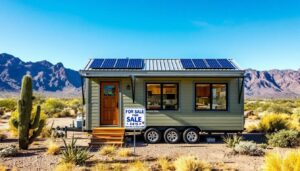
Arizona’s climate and lifestyle align exceptionally well with tiny house ownership. With over 300 days of sunshine annually, heating costs stay low and outdoor living extends year-round, a huge advantage when square footage is limited. Many tiny homeowners add covered porches, outdoor kitchens, or shaded seating areas, effectively doubling usable space without increasing the footprint.
The state’s relatively low cost of land compared to coastal markets makes it feasible to buy a parcel outright, especially in rural counties like Cochise, Yavapai, or Mohave. Lots under an acre can often be found for under $20,000, and zoning in unincorporated areas tends to be more flexible than urban jurisdictions. That flexibility is critical, since many cities still classify tiny houses on wheels (THOWs) as RVs rather than permanent dwellings.
Arizona also has a growing network of tiny house lifestyle blogs and communities that share resources, host meetups, and advocate for zoning reform. This grassroots support makes the transition to tiny living far less isolating than it might be in states where the movement is still niche.
Where to Find Tiny Houses for Sale in Arizona
Buyers have several avenues for finding tiny houses in Arizona. Online marketplaces like Tiny House Listings, Zillow, and Facebook Marketplace regularly feature both new builds and resales. Filtering by state and price range quickly narrows the field, though it’s essential to verify whether a listing includes land or is for the structure only.
Local builders and manufacturers are another strong option. Companies like Tiny Nest Homes (based in Phoenix) and Nomad Tiny Homes offer custom builds with Arizona-specific features like upgraded insulation, reflective roofing, and desert-toned exteriors. Custom builds typically run $50,000–$90,000 depending on size and finishes, but buyers get exactly what they need rather than retrofitting a pre-owned unit.
Tiny house expos and shows occasionally pass through Phoenix and Tucson, giving buyers a chance to tour models, talk directly with builders, and compare layouts side-by-side. These events also connect buyers with financing companies and land consultants who specialize in alternative housing.
Popular Tiny House Communities and Locations
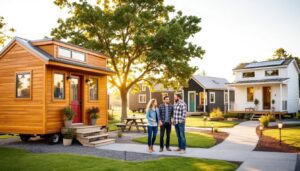
Several planned tiny house communities have emerged across Arizona, offering shared amenities, HOA-like governance, and a built-in social network. Examples include:
- Escalante Village (Durango, near the Arizona border): A mixed-use community with tiny houses, RVs, and small cabins. Residents share a community garden, workshop space, and event pavilion.
- Spur Cross Tiny Home Community (Cave Creek): A gated development north of Scottsdale with desert landscaping, hiking access, and utilities already in place.
- Private land co-ops in Cochise and Pima counties: Informal arrangements where multiple tiny homeowners share a large parcel, splitting well and septic costs.
Outside of planned communities, popular locations include Tucson (where tiny homes for sale are increasingly common), Prescott Valley, Sedona (pricier but stunning), and Quartzsite (a hub for RV and tiny house snowbirds). Always confirm local zoning before purchasing land or a home.
What to Expect: Pricing and Styles of Arizona Tiny Homes
Pricing varies widely based on whether the tiny house is a DIY shell, a turnkey build, or a custom design. As of 2026, expect the following ranges:
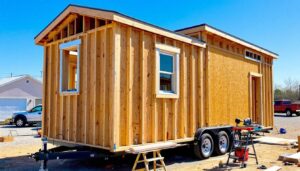
- Basic shells or unfinished models: $15,000–$30,000. Buyers finish interiors themselves, which cuts costs but requires significant DIY skill.
- Turnkey tiny houses (move-in ready): $40,000–$75,000 for homes between 200–400 square feet. This includes appliances, plumbing, electrical, and finish carpentry.
- High-end custom builds: $80,000–$120,000+. Features might include solar arrays, composting toilets, luxury finishes, or off-grid water systems.
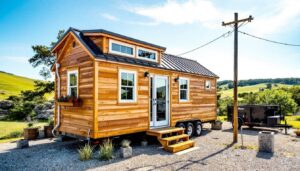
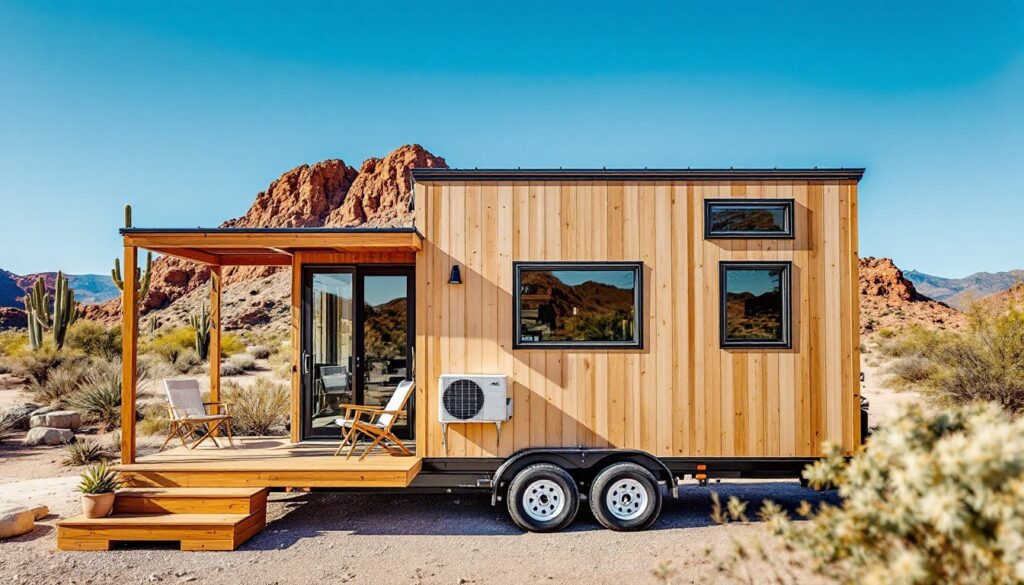
Style-wise, Arizona tiny houses often reflect Southwestern aesthetics: stucco or board-and-batten siding, metal roofs (which reflect heat better than asphalt shingles), and earthy color palettes. Interiors lean toward open-concept layouts with lofted sleeping areas, fold-down tables, and multi-function furniture.
Insulation is critical. Arizona’s summer highs routinely exceed 110°F in Phoenix and the low desert. Look for homes with at least R-13 wall insulation and R-30 in the roof. Spray foam is common in quality builds. Mini-split HVAC systems (1-ton capacity for most tiny houses) are the standard for cooling: window units struggle in extreme heat.
According to HomeAdvisor, the average cost to outfit a tiny house with off-grid solar in Arizona runs $8,000–$15,000 for a 3–5 kW system, depending on battery storage needs. Many buyers in rural areas opt for this to avoid utility hookup fees, which can exceed $10,000 in remote locations.
Arizona Zoning Laws and Regulations for Tiny Houses
Zoning is the single biggest hurdle for tiny house buyers in Arizona. The state has no unified tiny house code: regulations vary by county and municipality.
Tiny houses on wheels (THOWs) are typically classified as RVs. This means they’re legal to park in RV parks or on private land if the county allows RV habitation. Some counties (like Coconino) prohibit full-time RV living on residential lots. Others (like Cochise) permit it with few restrictions. Always check the county’s zoning ordinance or call the planning department before buying land.
Tiny houses on permanent foundations are generally treated as accessory dwelling units (ADUs) or primary residences, depending on size. Most jurisdictions require:
- Minimum square footage: Often 200–400 sq ft for a primary dwelling, though some rural counties have no minimum.
- Building permits: Required for any structure on a foundation. Expect plan review, inspections, and compliance with the International Residential Code (IRC).
- Setbacks: Structures must be a certain distance from property lines (commonly 10–25 feet). Corner lots and irregularly shaped parcels sometimes don’t have enough buildable area for code-compliant placement.
Navigating tiny house legal considerations can be complex, and hiring a local land-use attorney or consultant is worth the cost if the property is in a gray area. Some buyers form LLCs to purchase land, then lease it back to themselves, which can simplify certain zoning classifications.
Utility hookups also vary. Municipal water and sewer are available in developed areas, but rural buyers often need a septic system (budget $5,000–$10,000 for installation) and a well ($8,000–$15,000 depending on depth). Electrical service extensions can run $3,000–$7,000 per pole if the property is far from existing lines.
Financing Your Tiny House Purchase in Arizona
Traditional mortgages don’t apply to most tiny houses, especially THOWs, because they’re not considered real property. Buyers typically use one of these routes:
- Personal loans: Unsecured loans up to $50,000 are common, with interest rates ranging from 6–12% depending on credit. Terms usually run 5–10 years.
- RV loans: If the tiny house is certified by the Recreational Vehicle Industry Association (RVIA), it can qualify for an RV loan with rates around 4–8% and terms up to 15 years. Not all builders pursue RVIA certification, so confirm before assuming this option.
- Home equity lines of credit (HELOCs): Buyers who own other property can tap equity at relatively low rates (currently 7–9% as of early 2026).
- Cash: A significant portion of Arizona tiny house buyers pay outright, either from savings or by selling a larger home.
If the tiny house is on a permanent foundation and meets local building codes, some lenders will issue a traditional mortgage or construction loan. This is more common for homes over 400 square feet or when the buyer also owns the land.
Understanding the tiny home cost breakdown is essential before approaching lenders, as they’ll want to see a detailed budget that includes land, utilities, permits, and contingency funds. Lenders are more comfortable financing projects with clear, itemized plans.
Tips for Choosing the Right Tiny House in Arizona
Start by defining primary use: full-time residence, vacation getaway, rental income property, or guest house. This determines size, systems, and location priorities.
Inspect thoroughly. Tiny houses are still houses, and they’re subject to the same construction failures as conventional builds. Check for:
- Roof leaks: Water damage in a 200-square-foot space spreads fast. Look for stains on ceilings and around windows.
- Trailer condition (for THOWs): Axles, tires, brakes, and tongue weight all matter if the house will be moved. Rust, cracked welds, or dry-rotted tires are red flags.
- Electrical and plumbing: Verify work was done to code. DIY builds sometimes cut corners. If buying used, ask for documentation of any permitted work.
- Insulation and ventilation: Pull back outlet covers or check the attic hatch to confirm insulation is present and properly installed. Poor ventilation leads to condensation and mold, especially with propane heaters.
Consider climate-specific features. Arizona buyers should prioritize reflective or light-colored metal roofing, awnings or shade structures, and high-efficiency mini-split systems. Evaporative coolers (“swamp coolers”) work well in northern Arizona but are less effective in humid Tucson summers.
If buying land separately, confirm access to utilities or budget for off-grid systems. A quarter-acre lot with no water, sewer, or power isn’t a bargain if hookup costs exceed the land price. Tools like Curbed provide real estate trend data that can help identify emerging markets or overpriced areas.
Finally, don’t skip the permit process. Even if a county doesn’t actively enforce codes, unpermitted structures create problems during resale, insurance claims, or property disputes. Obtaining tiny house permits upfront protects the investment and keeps options open.
Safety note: Always wear a dust mask and gloves when inspecting older or DIY-built tiny houses. Check for mold, asbestos (in vintage trailers), or lead paint if the structure predates 1978.