Table of Contents
ToggleTucson’s housing market has pushed buyers toward creative solutions, and tiny homes have become more than a trend, they’re a practical answer to affordability and desert living. With sunshine 350 days a year, minimal heating costs, and a growing acceptance of alternative dwellings, the Old Pueblo offers unique advantages for tiny home buyers. But navigating sales channels, zoning rules, and financing takes assignments. This guide walks through everything from where to find units to what permits you’ll need before parking one on your lot.
Key Takeaways
- Tiny homes for sale in Tucson leverage the city’s mild climate, 350 days of sunshine, and lower cost of living, making them a practical and affordable housing solution compared to traditional homes.
- Tiny homes in Tucson come in three main types: tiny homes on wheels (THOWs, $50,000–$90,000 new), foundation-built units ($80–$150 per square foot), and prefab modular homes, each with different zoning and financing requirements.
- Tucson’s zoning regulations differ between city limits (ADUs require IRC compliance and municipal utilities) and unincorporated Pima County (more flexible for foundation-built tiny homes as primary dwellings), so verify your specific parcel’s zoning before purchasing.
- RV loans offer the easiest financing for certified tiny homes with rates around 7–11% APR, while construction loans and personal loans provide alternatives depending on whether you’re building on a foundation or buying a pre-built unit.
- Local builders like Tiny Homes of Arizona and online marketplaces like Tiny House Listings are primary sources for tiny homes for sale in Tucson, allowing you to inspect units in person and verify build quality before committing.
- Budget beyond the home’s purchase price for land ($25,000–$100,000+ depending on location and utilities), delivery ($2–$5 per mile), permits and inspections ($300–$600+ for foundation builds), and potential site work or solar installations to avoid cost surprises.
Why Tucson Is Perfect for Tiny Home Living
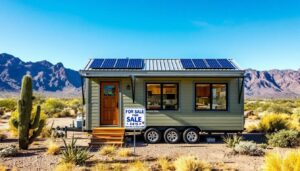
Tucson’s climate is the first advantage. Mild winters mean you won’t need the heavy insulation or propane consumption required in colder states. Summer heat is real, plan on a mini-split HVAC system rated for at least 12,000 BTU per 400 square feet, but solar panels offset cooling costs fast. Utility companies like TEP offer net metering, so a 3 kW rooftop array can zero out your electric bill in many months.
The city’s cost of living is lower than Phoenix or Flagstaff, and tiny homes amplify that savings. Median lot prices in unincorporated Pima County start around $25,000–$40,000 for parcels zoned for single-family dwellings, giving buyers room to place a tiny home without the price tag of Oro Valley or the Foothills.
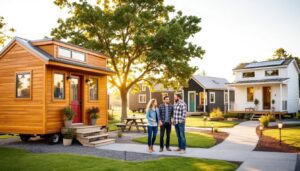
Community matters, too. Tucson has an active tiny home movement, with meetups, builder showcases, and off-grid advocates who share real-world experience. You’re not pioneering alone, there’s a network ready to help troubleshoot water catchment, composting toilets, and foundation options for caliche soil.
Types of Tiny Homes Available in Tucson
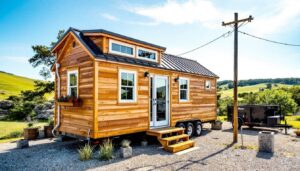
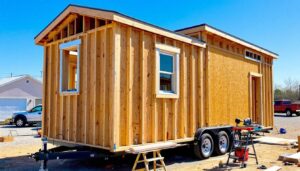
Tiny homes on wheels (THOWs) dominate the market. These are built on steel trailer frames, usually between 8.5 and 10 feet wide, and 20 to 30 feet long. They’re classified as RVs if they meet RVIA or NOAH standards, which affects where you can park them legally. Expect 7-foot-6-inch ceiling clearance inside due to road height limits.
Foundation-built tiny homes sit on permanent piers or slab foundations. These are treated like conventional dwellings under the International Residential Code (IRC) and require building permits. They’re a fit if you own land zoned R-1 (single-family residential) and want a unit that’s appraised like a house, not chattel.
Prefab modular units are factory-built in sections, delivered on flatbeds, and craned onto a foundation. Companies ship to Tucson from as far as Idaho and Texas. Modular homes must meet Arizona’s factory-built housing standards (Title 41, Chapter 16), which simplifies inspections but adds transportation costs, budget $3–$7 per mile for oversize loads.
Converted shipping containers show up occasionally. A single 20-foot container gives you 160 square feet: a 40-footer doubles that. Insulation is critical, bare steel turns into an oven. Spray foam (closed-cell, R-6 per inch) is the standard fix. Some buyers weld two containers into an L-shape for 320 square feet of living space.
Where to Find Tiny Homes for Sale in Tucson
Local builders offer the most customization. Tucson-area shops like Tiny Homes of Arizona and Sonoran Tiny Homes build to spec, so you can choose layouts, finishes, and electrical setups. Lead times run 3–6 months. Visit their lots to see completed units, photos don’t reveal things like cabinet hinge quality or how well trim joints are caulked.
Online marketplaces like Tiny House Listings, Tiny Home Builders, and Facebook Marketplace have active Tucson sections. You’ll find both new builds and resales. Always request the build date, whether it’s been lived in full-time, and if appliances (water heater, refrigerator, range) are included. For THOWs, ask for the trailer’s VIN and gross vehicle weight rating (GVWR), you’ll need those for insurance and registration.
RV dealers sometimes stock park model RVs or certified tiny homes. These units meet ANSI A119.5 standards and are easier to finance through RV lenders. Dealers handle title and registration, which simplifies paperwork. Models sit on dealer lots near I-10 and Ina Road.
Private land sales with tiny homes included pop up on Zillow and Realtor.com. Sellers list a tiny home already placed on a 1–5 acre parcel in unincorporated areas like Marana, Three Points, or Vail. You buy the land and dwelling together, which streamlines local zoning compliance since the unit’s already grandfathered or permitted.
Tucson Zoning Laws and Regulations for Tiny Homes
City of Tucson allows accessory dwelling units (ADUs) on R-1 and R-2 lots, but they must be foundation-built and meet IRC standards. Minimum size is 200 square feet, maximum is 1,200 square feet or 50% of the primary dwelling’s floor area, whichever is less. You’ll need a building permit, and the ADU must connect to city water and sewer, no composting toilets in city limits.
Pima County (unincorporated areas) is more flexible. Parcels zoned SR (suburban ranch) or larger allow one primary dwelling, and some permit tiny homes on foundations as that primary dwelling if they meet minimum square footage (varies by zone, check your parcel’s zoning code). THOWs are trickier: if classified as RVs, they can’t be permanent residences unless the land is zoned for RV parks or you apply for a special exception.
RV and mobile home parks are the simplest route for THOWs. Parks near Tucson like Voyager RV Resort and Desert Trails RV Park accept park models and certified tiny homes. Monthly rent runs $400–$700, covering water, sewer, and trash. Some parks have 11-month stay limits to maintain RV-park zoning.
Permits and inspections are unavoidable for foundation builds. Expect plan review fees around $300–$600, plus inspection fees for footing, framing, electrical, plumbing, and final. If you’re acting as owner-builder, you’ll pull permits yourself. Hiring a licensed contractor adds 15–25% to labor costs but ensures code compliance. Electrical work requires a licensed electrician per Arizona statutes, DIY wiring isn’t legal even on your own property.
Cost Breakdown: What to Expect When Buying a Tiny Home in Tucson
New THOWs built locally range from $50,000 to $90,000 for a turnkey 200–300 square foot unit. That includes appliances, a composting or RV-style toilet, a propane water heater, and basic finishes (vinyl plank flooring, laminate counters). Upgrade to hardwood, quartz, or custom cabinetry and you’re looking at $100,000+.
Used THOWs sell for $30,000–$60,000, depending on age and condition. Inspect the trailer frame for rust, especially around the axles and tongue. Check the roof membrane (TPO or EPDM) for punctures, desert sun degrades rubber over 5–7 years. Budget $2,000–$4,000 for a roof replacement if it’s due.
Foundation-built tiny homes cost $80–$150 per square foot, all-in. A 400 square foot unit on a pier-and-beam foundation runs $32,000–$60,000 for materials and labor, assuming you’re acting as general contractor. Add $5,000–$10,000 for site work (grading, utility trenching) and another $8,000–$12,000 for solar and battery storage if you’re going off-grid.
Land is a wildcard. Close-in parcels with utilities are $50,000–$100,000. Remote lots an hour outside Tucson drop to $10,000–$25,000 but require well drilling ($15,000–$30,000 for a 300-foot well) and septic installation ($8,000–$15,000 for a standard system). Understand the full cost of tiny home ownership before committing to raw land.
Delivery and setup for a THOW averages $2–$5 per mile from the builder. If you’re towing it yourself, you’ll need a 3/4-ton or 1-ton truck rated for 10,000+ pounds and a gooseneck or fifth-wheel hitch. Foundation leveling and blocking add $500–$1,500 depending on site conditions.
Financing Options for Tiny Homes in Arizona
RV loans are the easiest route for certified THOWs. Lenders like LightStream and Alliant Credit Union offer rates around 7–11% APR for 10–15 year terms. You’ll need a credit score above 680 and proof the unit meets RVIA or NOAH certification. Loan amounts typically cap at $100,000.
Personal loans work for smaller builds or used units. Terms are shorter, 5 to 7 years, and rates run higher (9–15% APR), but approval is faster and doesn’t require the home to be certified. Good fit if you’re buying a $40,000 used THOW and want to close quickly.
Construction loans apply if you’re building on a foundation. Arizona banks and credit unions offer lot-and-build loans, where they finance land purchase and construction in one package. Expect a 20–30% down payment and an interest rate 1–2 points above a conventional mortgage. Once construction is done and you pass final inspection, the loan converts to a standard mortgage.
Cash buyers have the most flexibility and negotiating power. Sellers often discount 5–10% for all-cash deals. If you’re liquidating a larger home to downsize, rolling equity into a tiny home purchase eliminates debt entirely.
Owner financing appears occasionally on private sales. The seller holds the note, and you make monthly payments directly to them. Terms vary, some want 10% down and a 5-year balloon, others offer 15-year amortization. Get a real estate attorney to draft the contract: Arizona doesn’t regulate owner-financed transactions as tightly as conventional mortgages.
Conclusion
Buying a tiny home in Tucson is doable, but it’s not as simple as parking a camper in the driveway. Know your zoning, line up financing, and budget for land or lot rent. The payoff is a low-overhead lifestyle in one of the Southwest’s most livable climates. Start by touring local builds, talking to county planning, and running the numbers on your specific parcel. The assignments now prevents headaches later.