Table of Contents
ToggleTiny house living demands smart energy solutions. Every square foot counts, and that same efficiency mindset applies to power systems. Tesla’s solar and battery technology has evolved beyond suburban rooftops, it’s now a practical fit for compact homes under 400 square feet. Whether parked on a foundation or sitting on a trailer, a tiny house with Tesla energy products can deliver grid independence without sacrificing modern conveniences. This guide walks through what it takes to integrate Tesla Powerwall batteries and solar panels into a tiny home, covering real-world installation challenges, cost breakdowns, and what it actually means to go off-grid in 2026.
Key Takeaways
- A tiny house Tesla setup combines solar panels with a Powerwall 3 battery to achieve grid independence while powering compact homes under 400 square feet efficiently.
- The Powerwall 3’s integrated inverter and compact design (43.25″ tall by 24″ wide) make it ideal for tiny homes, offering 11.5 kW continuous power without occupying interior space.
- Installation costs range from $18,000–$24,000 for a complete system, but off-grid tiny homeowners can achieve ROI in 7–10 years by eliminating generator fuel expenses.
- Proper roof mounting using metal-compatible clamps, correct wire gauging, and compliance with National Electrical Code standards are essential for safe solar panel installation on tiny houses.
- Off-grid tiny house living requires calculating daily consumption (typically 6–15 kWh) and planning for seasonal variations, as winter sun reduction may necessitate backup heating or additional batteries.
What Is a Tiny House Tesla Setup?
A tiny house Tesla setup combines Tesla Solar Panels with a Tesla Powerwall battery to create a self-sufficient energy system. Unlike traditional grid-tied homes, tiny houses often operate on 120V or 240V circuits with lower overall demand, typically between 5,000 and 15,000 watts of total capacity. That’s a fraction of what a 2,000-square-foot house pulls.
The core components include photovoltaic (PV) solar panels mounted on the roof or ground, a Powerwall 3 battery (13.5 kWh usable capacity), and an inverter to convert DC power from the panels into AC power for household circuits. Tesla’s latest Powerwall integrates the inverter directly into the battery unit, simplifying installation and reducing component count.
Tiny homes benefit from this setup because energy needs are manageable. A well-insulated tiny house with LED lighting, a mini-split heat pump, and Energy Star appliances can run comfortably on 20–30 kWh per day. One Powerwall can store nearly half a day’s worth of power, and a 3–4 kW solar array can replenish it during daylight hours. The system connects via Tesla’s app, which monitors production, consumption, and battery charge in real time.
This isn’t plug-and-play. Electrical work must meet National Electrical Code (NEC) standards, and most jurisdictions require permits for solar installations, even on movable tiny homes if they’re connected to a permanent power source. If your tiny house is classified as a recreational vehicle (RV) under local codes, permitting may differ.
Why Tesla Energy Solutions Are Perfect for Tiny Homes
Tesla’s energy products align with the core values of tiny house living: efficiency, simplicity, and independence. The Powerwall 3 delivers 11.5 kW continuous power and up to 185 amps of backup current, which is more than enough to handle a tiny home’s full load, including high-draw appliances like an induction cooktop or electric water heater.
The system’s software is another advantage. Tesla’s energy management algorithms prioritize solar usage during the day, store excess in the battery, and switch seamlessly to battery power after sunset. If you’re grid-connected, the system can also sell surplus energy back to the utility through net metering programs, though availability and rates vary by state.
For off-grid tiny house living, Tesla’s storm watch feature automatically charges the Powerwall to 100% when severe weather is forecasted, ensuring backup power when it matters most. The app also tracks energy production trends, helping homeowners adjust usage patterns to match solar availability.
Compact Design and Space Efficiency
Space is premium in a tiny house, and the Powerwall 3 measures 43.25 inches tall by 24 inches wide by 7.6 inches deep. It mounts directly to an exterior wall or post, freeing up interior square footage. Compare that to traditional lead-acid battery banks, which require ventilation, multiple units, and dedicated floor space.
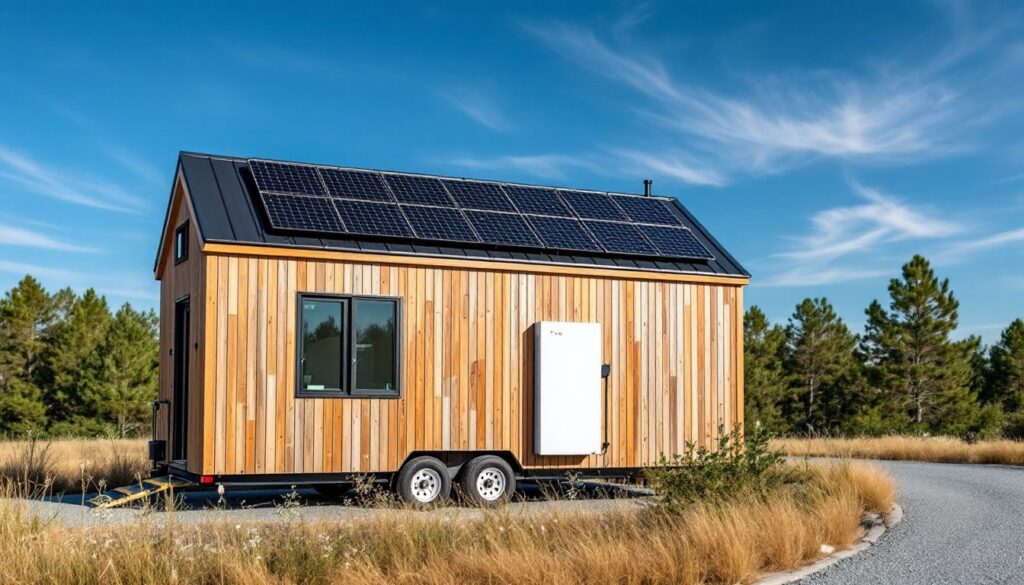
Tesla solar panels are also compact and modular. The standard 400W panels measure roughly 74.4 inches by 41.2 inches, and most tiny house roofs (typically 8 feet wide by 20–24 feet long) can accommodate 6–10 panels depending on pitch and obstructions. That’s 2.4–4 kW of generation capacity, which aligns well with tiny house consumption.
If roof space is limited due to lofts, skylights, or a curved roof design, ground-mounted arrays are an option. These require concrete footings or helical piers and allow for optimal panel angle adjustment, critical in northern latitudes where winter sun sits low on the horizon.
Tesla Powerwall for Tiny House Energy Storage
The Powerwall 3 is the current model as of 2026, replacing the Powerwall 2 with integrated inverter functionality and higher output capacity. For tiny homes, one unit is typically sufficient unless you’re running multiple high-draw appliances simultaneously or heating with electric resistance.
Installation requires a licensed electrician familiar with battery systems. The Powerwall connects to your main service panel (or a dedicated subpanel for off-grid setups) and includes a backup gateway that monitors grid status and switches to battery power during outages. The gateway also handles islanding protection, which prevents the system from backfeeding into the grid during maintenance, a critical NEC requirement.
For tiny houses on wheels, mounting presents unique challenges. The Powerwall weighs 287 pounds, so the mounting surface must be structurally sound. If your tiny house is built on a trailer, you’ll need to secure the unit to the trailer frame or an external post anchored to the ground. Vibration from road travel can damage battery internals, so most off-grid tiny house owners install the Powerwall at a stationary parking site rather than transporting it.
Battery performance varies with temperature. The Powerwall operates between -4°F and 122°F, but charge/discharge rates slow in extreme cold. If you’re in a climate with harsh winters, insulating the battery enclosure or installing it in a semi-conditioned space (like a utility shed) extends lifespan and maintains efficiency.
Many tiny homeowners explore legal considerations for placement before committing to a Powerwall installation, especially when parking on leased or shared land.
Installing Tesla Solar Panels on Your Tiny Home
Mounting solar panels on a tiny house roof follows the same principles as conventional roofing work, but with tighter tolerances. Most tiny homes use metal roofing (standing seam or corrugated), which simplifies panel attachment using non-penetrating clamps. These clamps grip the seam without drilling holes, preserving waterproofing integrity.
If your roof is asphalt shingle or EPDM rubber, you’ll need lag bolts secured into rafters with proper flashing to prevent leaks. Locate rafters with a stud finder or by tapping, they’re typically spaced 16 or 24 inches on center. Use stainless steel hardware rated for outdoor exposure: galvanized bolts will corrode over time, especially in coastal or high-humidity areas.
Panel orientation matters. In the northern hemisphere, south-facing panels capture the most sunlight year-round. Roof pitch affects output too, a 30–40 degree angle is ideal for most U.S. latitudes, though steeper pitches work better in northern states with heavy snow. Flat or low-slope roofs (under 15 degrees) reduce efficiency by 10–15% but are acceptable if you oversize the array slightly.
Wiring runs from panels to the Powerwall via conduit to protect against UV degradation and physical damage. Use 10 AWG or 8 AWG copper wire depending on array size and distance. Voltage drop should stay under 3% to maintain efficiency, calculate this using wire gauge charts available from the National Electrical Manufacturers Association (NEMA).
If your tiny house has a loft or skylight, panel placement gets trickier. You may need to split the array between front and rear roof sections, which requires a combiner box to merge strings before feeding into the inverter. For homes interested in advanced building methods, energy-efficient framing techniques can optimize structural support for panel loads.
Cost Considerations and ROI for Tiny Homeowners
As of 2026, a Tesla Powerwall 3 costs approximately $9,300 before installation, and professional installation adds $2,000–$4,000 depending on complexity and local labor rates. Solar panels run about $2.50–$3.50 per watt installed, so a 3 kW system totals $7,500–$10,500.
All-in, expect to invest $18,000–$24,000 for a complete Tesla solar-plus-battery system on a tiny house. That’s a significant chunk of change when the entire home might cost $50,000–$80,000 to build.
Return on investment (ROI) depends on whether you’re replacing grid power or generator fuel. If you’re grid-tied and paying $0.15 per kWh, a system producing 12 kWh/day saves roughly $650 annually, yielding a 28–37 year payback without incentives. But, the federal solar Investment Tax Credit (ITC) currently covers 30% of system costs, dropping payback to 20–26 years.
For off-grid tiny homes, ROI improves dramatically. Eliminating a $200/month generator fuel habit saves $2,400 per year, cutting payback to 7–10 years. Factor in generator maintenance costs (oil changes, spark plugs, carburetor rebuilds), and solar becomes cost-competitive within five years.
People researching upfront expenses for tiny living often overlook long-term energy costs, which can equal or exceed the home’s construction budget over a 20-year lifespan.
Going Off-Grid with Tesla Energy in a Tiny House
True off-grid living with Tesla energy requires careful load calculation and seasonal planning. Start by listing every electrical device in your tiny house, lights, fridge, water pump, laptop charger, microwave, and note its wattage and daily runtime. Multiply watts by hours to get watt-hours (Wh), then sum everything for total daily consumption.
For example, a typical off-grid tiny house might use:
- LED lights (50W for 5 hours): 250 Wh
- Mini-fridge (60W continuous): 1,440 Wh
- Laptop (50W for 6 hours): 300 Wh
- Water pump (120W for 0.5 hours): 60 Wh
- Microwave (1,000W for 0.2 hours): 200 Wh
- Mini-split heat pump (500W for 8 hours): 4,000 Wh
Total: 6,250 Wh or 6.25 kWh/day. Add a 20% buffer for inefficiencies and you’re at 7.5 kWh/day. A 3 kW solar array in a sunny climate (5 peak sun hours/day) generates 15 kWh daily, more than enough.
Winter changes the equation. In northern states, December might deliver only 2–3 peak sun hours, cutting production to 6–9 kWh. If heating demands spike to 10 kWh/day, you’ll drain the Powerwall nightly. Solutions include adding a second Powerwall, installing a propane or wood heat source as backup, or reducing consumption with better insulation and thermal curtains.
Permits and codes still apply to off-grid systems. Even if you’re not connecting to the utility grid, electrical work must meet NEC standards. Some counties require permits for any structure with plumbing or electrical systems, and inspectors will check for proper grounding, GFCI protection in wet areas, and correct wire sizing.
For homeowners integrating smart home technology with Tesla energy, the app’s API allows third-party integrations with home automation platforms, enabling energy-conscious automations like shutting off non-essential loads when battery charge drops below a threshold.
Be realistic about lifestyle adjustments. Off-grid living means you can’t run a space heater and an electric oven simultaneously on a cloudy day. Load management becomes second nature, you’ll learn to run the washing machine when the sun’s out and skip the hair dryer on overcast mornings. Tesla’s system makes it easier by providing real-time feedback, but discipline is still required.