Table of Contents
ToggleThe Craftsman style has endured for over a century because it values what matters: honest materials, thoughtful details, and built-to-last construction. Now that same ethos is showing up in tiny houses, where every square foot counts and quality trumps quantity. A Craftsman tiny house isn’t just downsizing, it’s a deliberate choice to live with character, craftsmanship, and intention. Whether someone’s building from scratch, buying a custom shell, or converting a trailer-mounted structure, understanding what makes a Craftsman design work in small spaces helps ensure the home feels grounded, functional, and genuine.
Key Takeaways
- A Craftsman tiny house combines the movement’s core principles—honest materials, handcrafted details, and practical design—into a space that feels intentional and character-filled rather than cramped.
- Essential architectural features like exposed brackets, multi-pane windows, horizontal lines, and built-in furniture make Craftsman tiny house designs both visually authentic and functionally efficient.
- Craftsman style works exceptionally well for tiny living because it prioritizes durability, built-ins, and multipurpose spaces, creating visual richness without clutter or unnecessary square footage.
- Bold exterior trim proportions (3.5 to 5.5 inches wide), tapered columns, and earthy two- or three-color schemes ensure a Craftsman tiny house reads as a genuine home rather than a camper, which can ease financing and zoning approvals.
- Interior elements like wood paneling, stained cabinetry with period-appropriate hardware, box-beam ceilings, and earth-tone tile define an authentic Craftsman interior while maintaining practicality in small spaces.
- DIY projects such as adding wainscoting, building window seats with storage, and installing corbels can transform a basic tiny house into a personalized Craftsman space without requiring a full remodel.
What Defines a Craftsman Tiny House?
Craftsman architecture emerged in the early 1900s as a reaction to the ornate, mass-produced Victorian homes that dominated the era. The style emphasized handcrafted details, natural materials, and practical design. When applied to tiny houses, those principles translate beautifully, compact doesn’t mean sacrificing character.
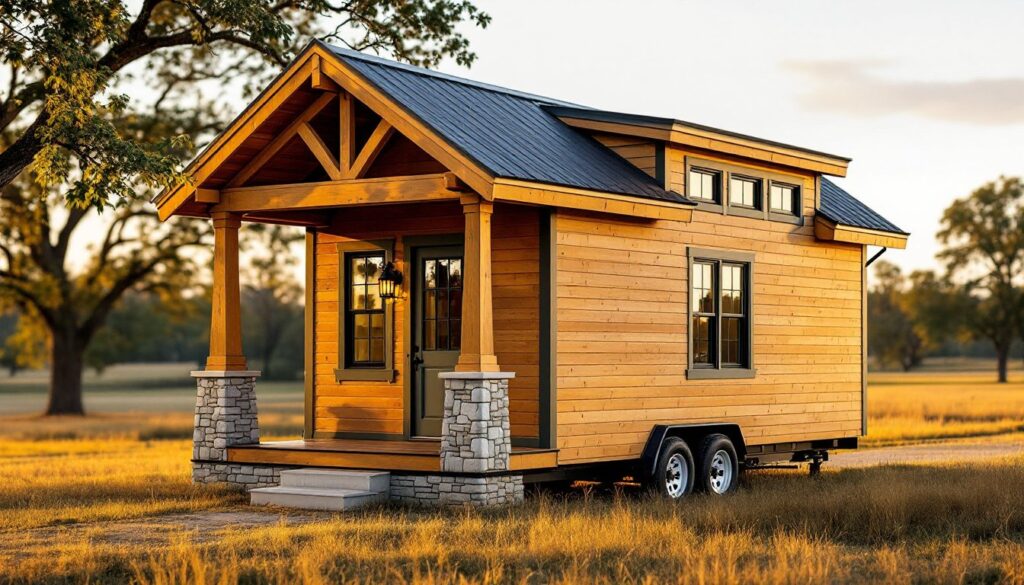
A true Craftsman tiny house borrows from the movement’s original vocabulary: low-pitched gable roofs, deep overhanging eaves with exposed rafter tails, and front porches supported by tapered square columns. Even on a trailer-mounted tiny house measuring 8.5 feet wide by 20 feet long, these proportions can be scaled down without losing their visual impact.
Material choice is critical. Craftsman homes traditionally used wood siding, stone accents, and natural shingles. In tiny house construction, this might mean cedar or pine lap siding (actual dimensions vary, but 1×6 or 1×8 nominal boards are common), stone veneer around the base or porch columns, and architectural shingles rather than metal roofing, though metal can work if the color and profile suit the aesthetic.
Key Architectural Features of Craftsman Tiny Homes
Even within tight constraints, several features remain non-negotiable for maintaining the Craftsman look:
- Exposed Brackets and Beams: Knee braces under the eaves and visible rafter tails add depth. These aren’t purely decorative, they can reinforce the roof structure, especially important when building on a trailer frame that experiences road vibration.
- Multi-Pane Windows: Divided-lite windows (often in a 6-over-1 or 4-over-1 pattern) are signature Craftsman elements. In tiny houses, these also allow better control over ventilation and natural light.
- Horizontal Lines: Wide trim boards, horizontal siding, and strong fascia emphasize the home’s connection to the ground. This helps a tiny house feel anchored rather than precarious.
- Built-In Furniture: Original Craftsman homes featured built-in benches, bookcases, and window seats. In a tiny house, these become essential space-savers. A built-in breakfast nook or under-stair storage with paneled doors maintains the aesthetic while solving practical problems.
Anyone building from plans should verify that roof pitch and overhang dimensions comply with road height limits if the house will be moved. The International Residential Code (IRC) Appendix Q addresses tiny houses on foundations, but trailer-mounted homes often fall under vehicle codes for transport.
Why Choose a Craftsman Style for Your Tiny House?
Not every architectural style adapts well to tiny living. Craftsman design works because it was always about efficiency, durability, and livability, not grandeur.
The style’s emphasis on built-ins and multipurpose spaces aligns perfectly with tiny house needs. Where a standard tiny house might feel like a trailer interior with cabinetry, a Craftsman tiny house uses wainscoting, box-beam ceilings, and plate rails to create visual richness without clutter. Those details don’t add usable square footage, but they make the space feel intentional rather than improvised.
Another advantage: Craftsman details age well. Wide trim boards hide gaps from settling or wood movement. Wood paneling and darker stains camouflage wear better than white shiplap or painted drywall. For anyone planning to live in their tiny house full-time, this matters.
From a resale perspective, Craftsman tiny houses hold appeal. The style reads as “real house” rather than “glorified camper,” which can make financing, insurance, and zoning conversations easier. Some jurisdictions with restrictive tiny house ordinances are more lenient when the structure resembles traditional residential architecture. That doesn’t guarantee approval, but it helps during planning and permitting conversations.
Finally, there’s the practicality of the deep eaves. In most climates, those overhangs protect siding and windows from weather, reducing maintenance. They also shade windows in summer, which helps with passive cooling, a real benefit when managing temperature in a small, well-insulated shell.
Design Elements That Make Craftsman Tiny Houses Stand Out
Getting the Craftsman look right in a tiny house comes down to a handful of high-impact choices. Skimping on these makes the design fall flat: getting them right makes 200 square feet feel like a considered, handcrafted space.
Exterior trim proportions need to be bold. On a full-sized Craftsman bungalow, trim might be 1×6 or 1×8 actual. On a tiny house, don’t shrink that too much, 3.5-inch to 5.5-inch wide trim still reads correctly at smaller scale. Corners, windows, and doors should all get substantial casing. Use a miter saw for clean 45-degree corners, and consider a Craftsman-style cap (a simple bevel or chamfer on the top edge of window trim) for authenticity.
Porch posts and columns are defining features. Tapered square columns (wider at the base, narrower at the top) can be built from dimensional lumber or purchased as pre-made fiberglass units. If building from scratch, construct a hollow box from 1×6 or 1×8 boards over a 4×4 structural post, tapering the box with angled cuts. Ensure the structural post is properly anchored to the trailer frame or foundation per local code, these columns often carry roof loads.
Color palette matters. Traditional Craftsman homes used earthy tones: olive, rust, brown, deep red, and warm grays. Trim is often a contrasting but complementary shade, not stark white. For a tiny house, a two- or three-color scheme (siding, trim, accent) keeps the exterior from feeling busy. Paint coverage typically runs around 350–400 square feet per gallon for exterior latex, so one gallon of each color is often enough for a standard tiny house shell, with a second gallon for touch-ups and future maintenance.
Lighting fixtures should echo the period. Mission-style sconces and pendant lights with leaded or amber glass fit the style without taking up floor space. Solar options exist for porch lights, but hardwired fixtures on a dimmer provide better control indoors.
For those exploring the broader landscape of compact living, current tiny home trends show that well-executed period styles like Craftsman continue to attract buyers and renters, particularly when combined with modern systems and insulation.
Interior Design Tips for Craftsman Tiny Homes
Inside a Craftsman tiny house, authenticity competes with practicality. The goal isn’t a museum replica, it’s a livable space that borrows the warmth and integrity of the original style.
Wood tones should dominate. Quarter-sawn oak was the traditional choice, but in a tiny house, lighter species like Douglas fir or poplar can prevent the interior from feeling cave-like. Stain rather than paint preserves the grain. Use tongue-and-groove paneling on ceilings or as wainscoting (typically 36 to 48 inches high) to add texture without bulk.
Built-in cabinetry is both practical and period-correct. A bench with lift-up storage under a window, a fold-down desk with cubby storage above, or open shelving with plate grooves all fit the Craftsman ethos. If building custom, use inset doors or flush-mounted hardware, avoid shiny modern pulls. Bin pulls, cup pulls, or hammered bronze knobs are more appropriate.
Box-beam ceilings (where beams are built from dimensional lumber in a grid pattern) add architectural interest and can conceal wiring or ductless mini-split lines. A simple version uses 1×4 or 1×6 boards arranged in a grid, with the spaces between painted or stained a shade darker.
Tile work in kitchens and baths should lean toward subway tile, hexagonal mosaics, or earth-tone ceramics. Grout lines and natural variation keep the look grounded. Avoid the glossy, bright white subway tile that’s common in modern tiny houses, it’s the wrong era. Detailed guidance on maintaining these finishes over time can be found in resources covering tiny house upkeep.
Window treatments matter more than many builders realize. Simple linen or canvas curtains on wooden rods, or wooden blinds with fabric valances, maintain the style. Roman shades work too, as long as the fabric isn’t too slick or modern.
Building or Buying a Craftsman Tiny House: What to Consider
Deciding between a DIY build, a custom builder, or a manufactured tiny house depends on skill level, budget, and timeline. Craftsman details can be incorporated at any level, but the degree of authenticity and structural integrity varies.
DIY builds offer full control. Plans specifically for Craftsman tiny houses are available from architects specializing in small homes, and resources like Fine Homebuilding provide detailed framing and trim tutorials. A confident DIYer with carpentry skills can handle most of the work, but a few tasks benefit from help: setting and leveling a trailer frame, installing a composting toilet or RV-style plumbing, and wiring for off-grid solar or grid-tied electric per NEC Article 551 (for RVs) or Article 550 (for mobile homes), depending on jurisdiction.
Expect 6 to 12 months for a part-time build, and budget for mistakes. Buying materials piecemeal often costs more than ordering in bulk. A typical Craftsman tiny house shell (framed, sheathed, roofed, and sided, but not finished inside) runs $15,000 to $25,000 in materials, depending on region and lumber prices.
Custom builders can deliver a turnkey Craftsman tiny house for $60,000 to $100,000 or more, depending on finishes and systems. The advantage is speed and craftsmanship, but the buyer gives up some design control. Interview builders carefully, ask to see completed projects, and confirm they understand the difference between cosmetic Craftsman details and structural soundness. A house that looks good in photos but flexes on the road or leaks after the first rain is a costly problem. Understanding the full cost breakdown helps set realistic expectations.
Manufactured or shell kits from companies specializing in tiny houses are a middle path. Some offer Craftsman-inspired designs, but the quality of trim, siding, and interior details varies widely. Inspect samples in person if possible. Cheaper kits may use vinyl siding, hollow-core doors, and thin trim that undermines the look.
Anyone buying or building should also research legal considerations specific to their location. Zoning, foundation requirements, and utility hookups differ dramatically between urban ADU lots, rural properties, and RV parks.
DIY Craftsman Tiny House Projects to Personalize Your Space
Even if someone buys a completed tiny house, a few DIY projects can push the design closer to authentic Craftsman style. These upgrades don’t require a full remodel, just solid carpentry skills and patience.
Add Wainscoting or Board-and-Batten Paneling: This transforms plain drywall into something with depth. Cut 1×4 or 1×6 boards to height (36 inches is standard for wainscoting), nail them vertically to studs, and top with a cap rail (a piece of shaped trim or a simple 1×3). Paint or stain to match the overall palette. A miter saw or table saw makes rip cuts easier, but a circular saw with a guide works too. Safety note: Wear eye protection and a dust mask, especially when cutting treated or stained lumber.
Build a Window Seat with Storage: Craftsman homes are known for cozy, built-in seating. In a tiny house, this doubles as storage. Frame a simple box under a window using 2×4 studs, add a plywood top, and hinge it for access. Finish with a cushion covered in durable fabric. The structure should be anchored to wall studs for safety, don’t rely on screws into drywall alone.
Install Corbels or Knee Braces: These angled brackets under shelves, counters, or eaves add instant Craftsman flair. They’re often decorative, but real structural knee braces (cut from 2× lumber at a 45-degree angle) can support a loft beam or reinforce a porch post. If installing outdoors, use pressure-treated or naturally rot-resistant wood like cedar. For those inspired by traditional building techniques, the handcrafted quality found in Amish-built tiny homes offers a reference point for joinery and finish quality.
Upgrade Cabinet Hardware and Light Fixtures: Swapping out builder-grade pulls and lights is one of the fastest cosmetic upgrades. Mission-style hardware and oil-rubbed bronze or matte black finishes align with Craftsman design. Fixtures from big-box stores often come with generic bulbs, consider warm-tone LEDs (2700K to 3000K) to avoid the harsh blue cast.
Create a Faux Box-Beam Ceiling: If the ceiling is already finished but feels flat, add box beams. Rip 1×4 or 1×6 boards into U-shaped channels, stain them, and attach them to the ceiling in a grid pattern using construction adhesive and finish nails. This hides wiring runs and adds visual interest. It also slightly lowers the ceiling, so it works best in lofts or vaulted spaces with clearance to spare.
These projects pair well with exploring tiny house lifestyle ideas to see how others balance aesthetics with daily living.
For design inspiration and small-space solutions that complement the Craftsman approach, Apartment Therapy offers walkthroughs of compact homes with period details. Meanwhile, This Old House provides step-by-step tutorials on trim work, window casing, and built-ins that translate directly to tiny house projects.
Final Thought
A Craftsman tiny house proves that good design doesn’t depend on square footage. It’s about proportion, materials, and care, values that matter just as much in 200 square feet as in 2,000. Whether someone’s framing from scratch or personalizing a purchased shell, the Craftsman approach rewards attention to detail and respect for the process. That’s a philosophy that fits tiny living perfectly.