Table of Contents
ToggleBuilding or buying a tiny house for under $10,000 isn’t just wishful thinking, it’s entirely achievable if you’re willing to roll up your sleeves and make smart material choices. While you won’t get a turnkey, Instagram-ready dwelling at this price point, you can absolutely create a functional, weather-tight structure that meets basic living needs. This budget requires strategic planning, DIY labor, and realistic expectations about finishes and amenities. Whether you’re converting a shed, assembling a kit, or building from scratch, hitting the $10,000 mark means prioritizing essentials over extras and understanding where your money delivers the most value.
Key Takeaways
- Building a tiny house under $10,000 is achievable through DIY labor, salvaged materials, and simplified systems like composting toilets and basic electrical setups.
- Labor costs are the biggest budget factor; doing the work yourself can save 40-60% compared to professional construction, though expect to invest 300-600 hours on a basic build.
- Tiny house conversions from prefab sheds (starting at $3,500-$6,500) offer the fastest route to an affordable dwelling when paired with basic insulation and finishes.
- Zoning and building permits are critical first steps; many jurisdictions have minimum square footage requirements or classify tiny houses differently, so verify local codes before purchasing materials.
- Using reclaimed materials, salvaged windows, and simplified interior finishes like painted OSB and vinyl tile dramatically reduces costs without sacrificing a functional, weather-tight structure.
- Expect limited financing and resale options with ultra-budget tiny houses; most require cash payment and perform best as guest houses, studios, or weekend retreats rather than primary residences.
What Makes a Tiny House Cost Under $10,000?
The difference between a $10,000 tiny house and a $50,000+ model comes down to five main factors: labor costs, material grade, size, systems complexity, and finishes.
First, labor is the biggest variable. A professionally built tiny house can run $80-$150 per square foot just for construction. When someone tackles the work themselves, they’re essentially trading time for that labor cost. Expect to invest 300-600 hours on a basic build.
Material selection dramatically affects budget. Using reclaimed lumber, salvaged windows, and basic plywood sheathing instead of new dimensional lumber and vinyl siding can cut material costs by 40-60%. A detailed cost breakdown shows how individual material choices stack up.
Square footage matters more than people think. An 8×12 structure (96 square feet) uses roughly one-third the framing lumber of a 10×20 (200 square feet). Staying under 120 square feet keeps most builds feasible under $10,000.
Simplified systems are non-negotiable at this price. Full residential plumbing, 200-amp electrical service, and HVAC systems blow the budget fast. Most ultra-affordable builds rely on composting toilets, basic 12V or limited 120V electrical, and wood heat or portable AC units.
Finally, interior finishes get minimal. Think painted OSB walls instead of shiplap, vinyl tile instead of hardwood, and open shelving instead of custom cabinetry. The structure is solid: the aesthetics are utilitarian.
Best Tiny House Options Under $10,000
DIY Kits and Prefab Shells
DIY tiny house kits typically range from $5,000 to $15,000, with several options landing in the sweet spot below ten grand. These kits usually include pre-cut lumber, fasteners, and basic instructions, essentially a large-scale furniture project.
Most affordable kits provide the shell only: wall framing, roof trusses, exterior sheathing, and sometimes windows and doors. Buyers still need to source insulation, interior finish materials, roofing, and all systems. The advantage is speed and reduced lumber waste: the disadvantage is less flexibility in design modifications.
Several manufacturers offer shells in the $4,000-$8,000 range for structures under 150 square feet. These are often delivered as flat-pack components. Expect assembly to take 2-4 weekends with a helper. Many tiny house kit options appeal to first-time builders who want a structured starting point.
Safety note: Even kit builds may require permits depending on intended use and local zoning. If the structure will be a dwelling, even temporary, check with your jurisdiction’s building department before ordering.
Converted Sheds and Storage Buildings
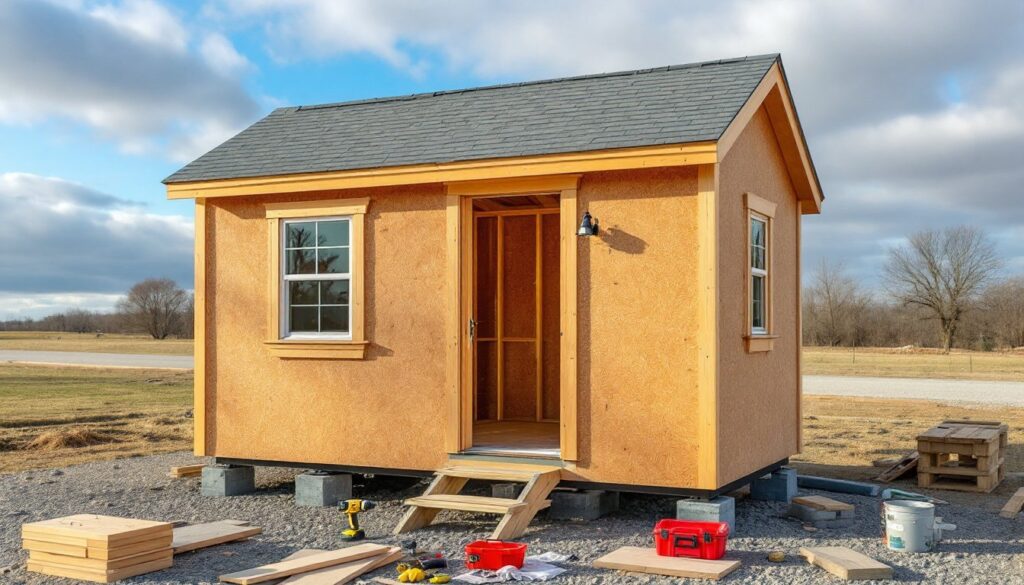
Prefab sheds offer the fastest route to a sub-$10,000 tiny house. A quality 12×16 storage building runs $3,500-$6,500 delivered. That leaves $3,500-$6,500 for insulation, electrical, a small bathroom setup, and finishes.
Look for sheds with actual 2×4 framing on 16-inch centers, not thin panels. The structure needs to support insulation and interior finish weight. Verify the floor joists: many economy sheds use 2×4 joists that aren’t suitable for constant habitation. Upgrading to 2×6 floor joists adds about $200-$300 but prevents long-term sagging.
Windows are often the weak point. Most shed windows are single-pane and non-opening. Budget $400-$800 to replace them with double-pane, operable units for proper ventilation and energy efficiency.
Roofing on standard sheds is typically architectural shingles on OSB decking, adequate for a dwelling if the pitch is at least 4:12. Anything flatter may need upgraded waterproofing.
One major consideration: delivery and setup. Most shed companies include delivery within 50 miles and will set the building on blocks or a gravel pad. Verify the delivery zone and any site access requirements, tight driveways or soft soil can add cost.
Building Your Own Tiny House on a Budget
Building from scratch offers maximum control and potentially the lowest cost, if you’re comfortable with framing, roofing, and basic systems work. Here’s a realistic approach.
Foundation and framing: Most $10,000 builds use a skid foundation, two or three treated 6×6 or 4×6 beams running the length of the structure, set on compacted gravel and concrete blocks. This keeps the build mobile (no permanent foundation permit in many areas) and costs $200-$500 depending on size. Alternatively, a simple post-and-beam foundation with concrete deck blocks runs $150-$300.
Framing a basic 10×16 structure requires roughly:
- Wall framing: 30-40 2×4 studs, 6 treated 2×4 bottom plates, 6 standard 2×4 top plates (~$250)
- Roof trusses: Either site-built from 2×4 stock or prefab trusses delivered ($300-$600 depending on pitch and span)
- Floor joists: 10-12 2×6 joists on 16-inch centers ($180)
- Sheathing: 12 sheets 7/16-inch OSB for walls, 8 sheets ½-inch CDX plywood for roof, 8 sheets ¾-inch tongue-and-groove for floor (~$500 total)
Roofing: Architectural shingles cost about $90 per square (100 sq ft). A 10×16 with a simple gable probably needs 2.5-3 squares plus underlayment, drip edge, and ridge cap, budget $350-$450.
Windows and doors: This is where salvage makes sense. Habitat for Humanity ReStores, Craigslist, and salvage yards often have perfectly good used windows for $25-$75 each. A salvaged exterior door runs $50-$150. New, you’re looking at $200-$400 per window and $250+ for a basic steel door.
Insulation and interior: Fiberglass batts are cheapest, R-13 for walls and R-30 for ceiling run about $300-$400 for a 10×16. Some builders use rigid foam board scavenged from construction sites (verify it’s clean and undamaged).
Interior walls can be ½-inch drywall (cheapest), painted OSB (industrial look, saves money), or reclaimed wood (if you’ve got a free source). Drywall for a small structure costs $200-$300 including joint compound and tape.
Electrical: A basic 12V system with a couple LED fixtures, USB outlets, and a small inverter can run off a single deep-cycle battery charged by a solar panel. Total cost: $300-$600. For 120V service, hire a licensed electrician for the panel and service entry ($500-$800), then DIY the interior runs if code allows. Always check local regulations before wiring.
Plumbing: Skip it entirely or go minimal. A composting toilet ($50-$1,200 depending on model) eliminates the need for a septic connection. A small tankless propane water heater ($150-$300) can serve a single shower and sink. For cold climates, PEX is the best choice, easy to work with and freeze-resistant if drained.
Free plans and resources: Sites like Ana White offer detailed building plans for small structures, often adaptable to tiny house use. Many builders also share their material lists and lessons learned in online forums.
PPE reminder: Always wear safety glasses when cutting, work gloves when handling lumber and metal, a dust mask when working with insulation or cutting treated wood, and hearing protection when using power saws.
Essential Considerations Before Buying or Building
Zoning and permits are the first hurdle. Many jurisdictions have minimum square footage requirements for dwellings, often 120-400 square feet depending on the county. Some classify tiny houses on skids as RVs, which may only be allowed in RV parks or on agricultural land. Others treat them as accessory dwelling units (ADUs), subject to setback and utility requirements. Call your local planning department early.
If the structure is on a permanent foundation and used as a dwelling, it almost certainly requires a building permit. Skid-mounted builds in some areas can skirt this if classified as temporary or recreational, but don’t assume. Unpermitted dwellings can result in fines, orders to demolish, or complications when selling property.
Land access and utilities matter. If building on raw land, factor in road access, utility hookups, and well/septic if going off-grid. Even a modest well costs $3,000-$8,000: septic systems start around $3,000. Many $10,000 tiny house owners rely on RV-style hookups at existing sites or landowner agreements for water and power.
Resale and financing are limited. Most lenders won’t finance a structure under $50,000 or without a permanent foundation. This is a cash-or-personal-loan project. Resale depends heavily on local demand: some markets have active tiny house buyers, others don’t.
Climate and insulation can’t be afterthoughts. An uninsulated or poorly sealed structure is miserable in winter and summer. In cold climates, plan for R-19 to R-21 walls and R-38+ ceiling insulation. In hot climates, focus on ventilation, reflective roofing, and shade.
Heating and cooling: A small wood stove (if code allows) costs $300-$800 and handles heating in spaces under 200 square feet. For cooling, a window AC unit ($150-$300) works but demands significant electrical capacity. Many builders integrate ceiling fans and strategic window placement to maximize natural ventilation.
Water and waste: If connecting to municipal water/sewer isn’t an option, explore RV-style fresh and gray water tanks, rainwater collection (check local regs), and composting toilets. These systems work but require routine maintenance and a learning curve.
Consider how the space will actually be used. A 100-square-foot structure is tight for full-time living but perfectly viable as a guest house, studio, or weekend retreat. Setting realistic expectations prevents buyer’s remorse.
Finally, understand that a $10,000 tiny house is a starter or minimalist build. It’s livable, but upgrades and improvements will likely follow. Budget a small contingency, $500-$1,000, for the inevitable surprises: extra fasteners, a forgotten junction box, or that one board that arrives warped. Many people exploring <a href="https://umonistudio.com/eco-friendly-tiny-homes/”>eco-friendly tiny homes appreciate how affordable builds can still incorporate sustainable practices like reclaimed materials and passive solar design.
Conclusion
A tiny house under $10,000 is absolutely doable, but it requires sweat equity, material savvy, and a willingness to prioritize function over finish. Whether starting with a shed conversion, a kit, or a ground-up build, the key is planning every dollar and understanding local codes before the first board is cut. Done right, it’s a foundation for affordable, intentional living.