Table of Contents
ToggleTimber framing isn’t just construction, it’s a centuries-old craft that turns structural bones into visual showpieces. When applied to tiny houses, this technique creates homes that feel both massive and intimate, where exposed beams and joinery tell the story of how the building stands. If someone’s considering a timber frame tiny house, they’re committing to quality, authenticity, and a structure that can outlast most conventional builds. This guide walks through what timber framing really means for tiny home builders, what it costs, and whether it’s a realistic DIY project or better left to pros.
Key Takeaways
- A timber frame tiny house uses heavy timber posts and beams with traditional mortise-and-tenon joinery to create a durable structure that can last 100+ years with minimal maintenance.
- Timber framing for tiny homes typically costs $18,000–$41,000, with exposed beams serving as both structural elements and interior aesthetics, reducing the need for interior load-bearing walls.
- DIY timber frame building requires 80–150 hours of joinery work and woodworking experience, while hiring professionals costs $12,000–$25,000 but saves time and reduces the risk of costly mistakes.
- Pre-cut timber frame kits from specialized companies offer a middle-ground option, ranging from $8,000–$15,000 with joinery already machined and detailed plans included.
- Proper planning for a timber frame tiny house must account for trailer weight capacity, timber sourcing lead times (4–8 weeks), local building codes, and foundation or tie-down requirements.
- Timber framing distributes structural loads through compression and joinery strength rather than fasteners, making it ideal for mobile tiny homes that experience road vibration and constant movement.
What Is a Timber Frame Tiny House?
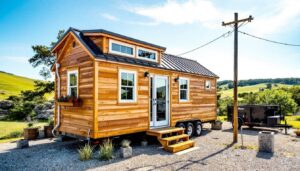
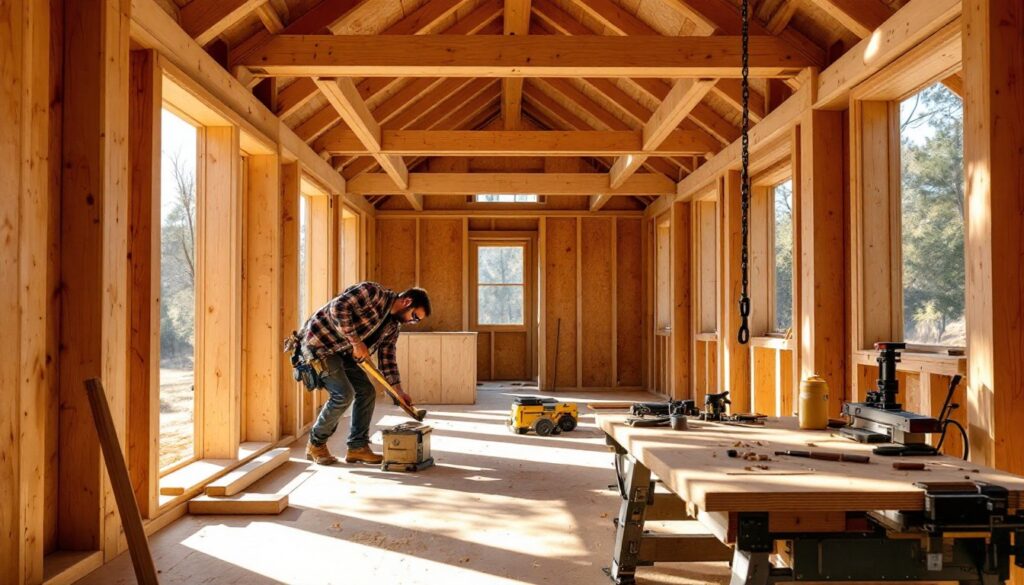
A timber frame tiny house uses heavy timber posts and beams joined with traditional mortise-and-tenon connections, secured with wooden pegs or metal fasteners. Unlike conventional stick framing (which hides 2×4 or 2×6 studs behind drywall), timber framing puts the skeleton on display. The structural frame becomes the interior aesthetic.
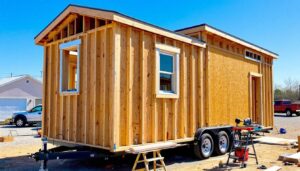
Most timber frame tiny homes fall into the 100–400 square foot range, built on trailers for mobility or on permanent foundations. The frame itself typically uses 6×6, 6×8, or 8×8 timbers depending on span and load requirements. Walls are often infilled with SIPs (structural insulated panels), traditional stud framing, or even straw bale for off-grid builds.
This isn’t the same as post-and-beam construction, though people use the terms interchangeably. True timber framing relies on joinery, no metal brackets or plywood gussets holding things together at the connections. That craftsmanship is part of what makes it special, and part of what drives up cost and complexity.
Why Choose Timber Framing for Your Tiny Home?
Durability and Structural Strength
Timber frames distribute loads through compression rather than relying on shear strength of fasteners. When properly designed and assembled, a timber frame can handle snow loads, wind shear, and settling that would rack a conventional stud wall. Many Amish-built structures use similar heavy timber techniques, and those buildings regularly stand for 100+ years with minimal maintenance.
The joinery itself, especially drawbored pegs that tighten as wood shrinks, creates connections that grow stronger over time. That’s a real advantage in a tiny house on a trailer, where road vibration and movement stress every fastener. Timber frames flex slightly without failing, which is exactly what a mobile structure needs.
For tiny homes on permanent foundations, timber framing easily meets or exceeds IRC load requirements for residential construction. Builders should still pull permits and have an engineer stamp the plans if the structure is over 200 square feet or considered a permanent dwelling. Codes vary by jurisdiction, and timber framing doesn’t exempt anyone from local building standards.
Aesthetic Appeal and Natural Beauty
Exposed timbers bring warmth and texture that drywall and paint can’t match. The wood grain, natural imperfections, and visible joinery give tiny homes character without needing much interior decoration. This matters in small spaces, where every design choice is magnified.
Species choice affects both look and budget. Douglas fir and Southern yellow pine are common and affordable, with tight grain and good structural properties. White oak and reclaimed barn timbers cost more but deliver richer color and history. Whatever species is chosen, the wood should be kiln-dried or air-dried to 12–15% moisture content before cutting joinery. Wet timbers will shrink and throw connections out of alignment.
Timber framing also reduces the need for interior load-bearing walls, opening up floor plans. In a 200-square-foot tiny house, eliminating even one wall partition can make the space feel twice as large. The frame does the work, so the infill walls are purely for enclosure and insulation.
Planning Your Timber Frame Tiny House Build
Start with a realistic floor plan and elevations. Software like SketchUp or timber-specific programs (Cadwork, Dietrich’s) help visualize joinery and timber layout. If someone’s new to timber framing, they should buy or adapt plans from an experienced designer. Cutting a mortise in the wrong place isn’t fixable, that timber is scrap.
Key planning considerations:
- Trailer size and weight capacity (if mobile): A 20-foot flatbed trailer typically maxes out around 10,000 lbs GVWR. Timber adds weight fast, an 8×8 timber runs about 50 lbs per linear foot for Douglas fir. Calculate frame weight before committing to timber sizes.
- Timber sourcing and lead times: Local sawmills can cut custom dimensions cheaper than big-box stores, but expect 4–8 week lead times for kiln drying. Reclaimed timbers need inspection for metal (old nails, bolts) that can wreck saw blades and joinery chisels.
- Joinery complexity: Mortise-and-tenon joints require precision. A timber frame raising typically happens in one or two days, but cutting the joinery can take weeks. Hand tools (slicks, framing chisers) are traditional but slow. A chain mortiser or portable bandsaw mill speeds things up.
- Foundation or trailer prep: Permanent foundations need frost footings per local code. Trailers need proper tie-down points welded or bolted to the frame to anchor the timber sill beams.
Builders should also account for infill wall systems early. SIPs are fast and well-insulated (R-23 to R-50 depending on thickness) but require a crane or multiple people to set panels. Stick-framed infill with spray foam or batt insulation is more forgiving for solo builders. Anyone interested in small space shell options will find that planning the envelope early saves headaches during assembly.
Permits are non-negotiable for permanent structures. For mobile tiny homes, zoning and legal requirements vary widely. Some jurisdictions classify them as RVs (requiring RVIA certification), others as accessory dwelling units (requiring full code compliance). Verify local rules before spending money on materials.
Cost Breakdown: What to Expect When Building
Timber framing costs more upfront than stick framing, but the price gap narrows when considering longevity and reduced interior finish work. Here’s a realistic breakdown for a 200-square-foot timber frame tiny house as of 2026:
- Timber materials (posts, beams, joinery): $3,000–$6,000 depending on species and whether timbers are milled on-site or purchased pre-cut.
- Fasteners and hardware (pegs, brackets, lag screws): $300–$600.
- Trailer (if mobile): $3,500–$6,000 for a heavy-duty flatbed rated for the load.
- Infill walls and insulation (SIPs or stick-frame): $2,000–$5,000.
- Roofing (standing seam metal or asphalt shingles): $1,200–$2,500.
- Windows and doors: $1,000–$3,000.
- Interior finishes (plumbing, electrical, fixtures, flooring): $5,000–$10,000.
- Foundation (if permanent): $2,000–$8,000 depending on frost depth and pier vs. slab design.
Total estimated cost: $18,000–$41,000. That range is wide because material grades, regional pricing, and DIY vs. hired labor all shift the numbers. For comparison, a detailed breakdown of tiny home budgets shows that conventional stick-frame builds often land in the $15,000–$35,000 range for similar square footage.
Pre-cut timber frame kits (from companies like Vermont Timber Works or Riverbend) run $8,000–$15,000 for a small kit with joinery already machined. That’s a middle path for builders confident in assembly but not joinery layout. Kits include detailed plans and sometimes on-site raising assistance.
Don’t forget tool costs if starting from scratch. A quality chainsaw mortiser is $500+, timber framing chisels and slicks another $300–$500, and a portable bandsaw mill (if milling on-site) runs $3,000–$8,000. Renting or borrowing tools makes sense for a one-off build.
DIY vs. Hiring Professionals: Which Route Is Right for You?
DIY timber framing is possible but demands woodworking skill, patience, and at least one experienced helper. Cutting accurate joinery with hand tools or a chain mortiser takes practice, expect the first few joints to fit poorly. Many DIYers attend a hands-on timber framing workshop before starting their own build. Workshops typically run 3–5 days and cost $500–$1,500, but the education prevents expensive mistakes.
Pros of DIY:
- Labor savings of $10,000–$25,000 compared to hiring a framing crew.
- Complete control over materials, joinery style, and timeline.
- Deep satisfaction in building something with traditional techniques.
Cons of DIY:
- Cutting joinery for even a small frame takes 80–150 hours.
- Timber frame raising requires 4–6 people for safety. A ridge beam on a 12-foot-tall frame isn’t a solo lift.
- Mistakes in joinery or layout mean re-cutting timbers or compromising structural integrity.
Hiring professionals makes sense for anyone without woodworking experience or time to learn. A timber frame company will design, cut, deliver, and raise the frame in 1–3 days. Total cost for professional framing (materials + labor) runs $12,000–$25,000 for a tiny house frame, depending on complexity.
Hybrid approaches work well: hire a pro to cut the joinery, then DIY the infill walls, roofing, and finishes. Or buy a pre-cut kit and hire help for the raising day only. Builders who go this route save money while keeping the project moving.
Safety gear is non-negotiable either way. Steel-toed boots, work gloves, safety glasses, and hearing protection are required when running saws and chisels. Raising day adds fall protection, harnesses and lanyards if working above 6 feet, per OSHA guidelines. Timber framing involves heavy lifts and sharp tools: taking shortcuts on PPE is how people get hurt.
For those exploring sustainable tiny home options or curious about ongoing upkeep needs, timber framing offers a durable, low-maintenance structure that aligns with long-term minimalist living. With the right planning and realistic expectations, a timber frame tiny house delivers both beauty and resilience.